Encounters with Jilly
Dame Jilly Cooper, 1937-2025

University of Edinburgh, 2003
It’s the first week of a new term of my third year at Edinburgh University, where I’m well on the way to scraping a 2:1 MA (Hons) in English Literature. I’m in a tutorial in Buccleuch Place, meeting my Modern Feminist Literature professor for the first time. We are asked to introduce ourselves, and tell everyone what our favourite book is.
It’s my turn. I pause. “Well,” I say. “It depends whether you mean my favourite literary work. That would be Wide Sargasso Sea.” The professor nods appraisingly. I take a breath, continue. “But my favourite author would be Jilly Cooper.”
A titter of laughter runs round the room.
“That is the worst reply I’ve ever heard to that question,” the professor scoffs. “Worse even than the person last year who said it was Harry Potter.”
Howgate, Midlothian, 1997
Let’s delve back further. I’m 17, and desperately trying to figure out what to do with my life. A long held ambition to go to vet school had recently being abandoned, when I realised I wasn’t going to get straight As in my exams, and that I didn’t particularly like dealing with blood or gore. I am studying Biology and Chemistry, with the intention of becoming an Equine Physiotherapist. In truth, I find the subjects of English and History much easier and more interesting, and I repeatedly question if I am following the right path. I have recently become obsessed with Jilly Cooper, and am working my way through her entire back collection. I dream of one day writing novels like hers. I have old A4 notebooks filled with such attempts.
For my Certificate of Sixth Year Studies (a now defunct Scottish qualification, on par with an A Level, but taken over one year instead of two), I’m writing a dissertation. It is about the conflict of good and evil in the writings of Oscar Wilde, well-disguised in his children’s story The Selfish Giant, less so in his play The Importance of Being Earnest, and fully explored in Salomé and The Picture of Dorian Gray. A quote comes to mind that I want to include in the introduction to my final draft: ‘For he who lives more lives than one / More deaths than one must die.’ I reread several of his works, searching for the quote, to no avail. This is the 1990s, and I don’t yet have access to the internet - whereas today I could find the answer within seconds. Instead I ask a few people, I flick through Wilde’s Collective Works hoping to find the sentence, but I’m drawing a blank.
Days later, I pick up the paperback of my favourite novel Rivals, bought second hand and now totally dog-eared and cracked of spine due to my repeated rereads. I reach the chapter when Cameron Cook is indulging in a spot of professional skullduggery as well as having a torrid affair with Cooper’s eponymous hero, Rupert Campbell-Black… and there’s the quote. It’s not attributed to anyone, and it’s paraphrased to suit Cameron’s situation, but that’s not unusual for Cooper’s characters, who often drop in literary quotes into conversation, whatever their background or profession. Through Cooper I had been introduced to American poet Robert Frost, and Ireland’s WB Yeats.
I flick back to the introduction to Rivals, the second novel Jilly wrote and the follow-up to her runaway success Riders (another book I love, but perhaps not as much as the perfectly-formed Rivals and Polo and the ridiculously-titled The Man Who Made Husband’s Jealous, which formed my introduction to her writing). She signs off: Jilly Cooper, Bisley, Gloucestershire. I handwrite a letter to her, addressed as such, holding out little hope that it would reach her. In the letter I tell her how much I love her writing and asking if the quote from Rivals originally came from Oscar Wilde.
A few weeks later I receive a letter. It is headed with the name Jilly Cooper, drawn in a cartoonish style in the shape of a dog, if I recall correctly. Maybe I still have the letter somewhere, lost in the chaos of old paperwork stored in my garage. One day I hope I will find it.
Dear Victoria, she wrote. I have a god daughter called Victoria Gray (my maiden name), and it is such a gorgeous name.
You are quite right, she wrote, the quote was from Wilde’s Ballad of Reading Gaol. I looked up the poem, and there it was. I completed the dissertation, got an A in my English exam.
Later, after a brief stint trying to become an Equine Physio, I changed track and went to study English at Edinburgh. I loved Austen, and Shakespeare, and Jean Rhys, and Robert Frost and WB Yeats, and all the while, I loved Jilly Cooper too.
St Pancras, London, 2006
My first job after graduating was with Horse & Hound. I spend my days writing about the world Jilly made me fall in love with, interviewing top riders, going to equestrian events. Most of my colleagues are avid Jilly fans. None would sneer if I described her as my favourite author; instead many would agree. During lunch or at after-work drinks we occasionally talk about Rupert and Ricky and Lysander as if they were real people; that is perhaps Jilly’s biggest strength as a writer.
Jilly is doing a Q&A session in a champagne bar in the recently revamped St Pancras station, and I’ve managed to get tickets for myself and my two former university flatmates, who like me have moved to the capital to embark upon our new careers. During our studies, I had introduced them to Jilly’s work, and while they’re both far cleverer and much better read than I am, they end up loving her writing too.
I’m thrilled to finally be in the same room as Jilly. She is just as I imagined - funny, warm, giggly, self-deprecating, often silly but incredibly sharp and astute. Later, she walks round the room saying hello to the people, and she stops by our table, places her hands on our heads. Darlings! Such gorgeous hair! We laugh, and beam, embarrassed but thrilled. Standard Jilly, over effusive, ridiculously complementary, but you can’t help but bask in her attention. She is magnetic.
Cheltenham Racecourse, c 2009
This memory is hazy, like many of my my days at racecourses around that time. The blur of horses, people, glasses of white wine, gossip with my friends.
I’m in a marquee with my friend Amy; I can’t remember if we popped by to see someone or if we’d been there all day. All I remember is that Jilly was there, accompanied by her son Felix, because she was in the midst of writing or promoting Jump!, her novel about National Hunt racing. She was sitting next to Richard Phillips, and she introduced him to her table. “This is Richard Phillips, the HANDSOMEST trainer in England,” she announced in true Jilly style, probably to his mortification. It reminds me of the moment when we first met her a few years earlier, in St Pancras, my friends and I, fresh-faced graduates with our allegedly gorgeous hair.
South East London, 2010
I’m writing full time by this stage, having moved from Horse & Hound to its sister title Horse and from there into the world of freelancing. Soon, I’ll start working as Press Officer of Hickstead, a position I still have 15 years later. Incidentally, Hickstead was the inspiration for Crittleden in Riders, and many of the stories that feature in Hickstead’s archives were used in Cooper’s novel about showjumping. The unusual Bank that caused Jilly’s riders to stage a protest - that was the Irish Bank at Hickstead. The rider who was ostracized for daring to jump it? That was Marion Mould. Interestingly, William Funnell - the rider who has now won the most Hickstead Derby titles - was the stunt double for Rupert Campbell-Black in the 1990s TV series of Riders.
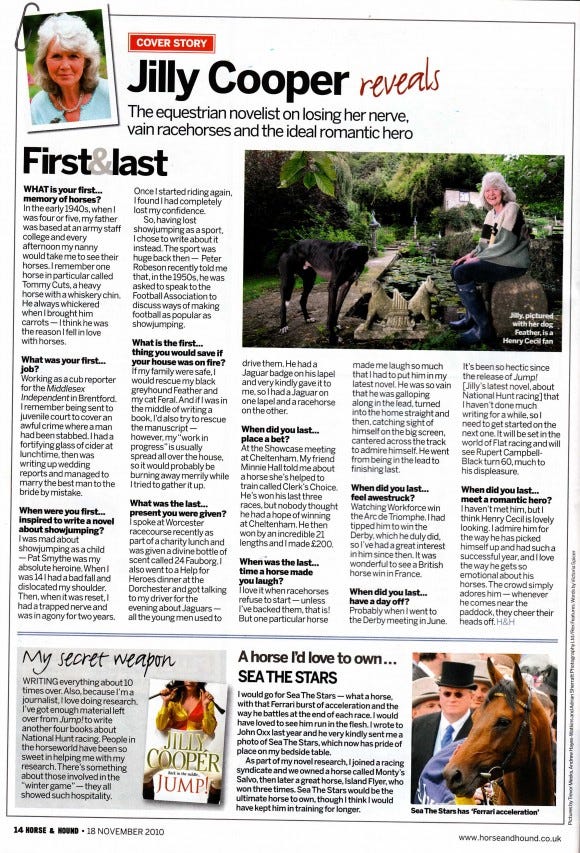
One day, I am commissioned to write a short Q&A with Jilly for Horse & Hound. I remember being terribly nervous about speaking to her on the phone, but she immediately put me at ease. She tells me witty stories and makes me laugh. I’m too nervous to tell her how much of an influence she has been on my life, how much I’ve loved her books, how often I’ve reread them, how touched I was that she once replied to my letter. How, in no small way, she changed and shaped my life.
Today, more than ever, I wish I had.
I wish I had.